


RFID: from the right label to the posting in your ERP
Barcode or RFID?
Process, data volume and environment decide which technology fits. Barcodes are inexpensive and proven, RFID captures without line of sight and in bulk.
| 1D barcode | 2D code | RFID | |
|---|---|---|---|
| Data capacity | low, e.g. item number | high, in a small area | high, rewritable |
| Capture | one at a time, line of sight | one at a time, robust if damaged | in bulk, contactless |
| Cost per label | lowest | low | higher |
| Ideal for | warehouse, shipping, retail | UDI, electronics, small parts | stocktaking, tracking, gates |
Frequencies at a glance
| Band | Frequency | Typical read range (passive) | Typical use |
|---|---|---|---|
| LF | 125 to 134 kHz | a few centimetres | access control, animal identification, tools |
| HF and NFC | 13.56 MHz | a few centimetres to about 1 m | healthcare, libraries, ID cards, smartphones |
| UHF | 865 to 868 MHz in Europe | several metres | logistics, retail, warehousing, load carriers |
Typical values, depending on tag, antenna, power and environment. In warehousing, logistics and retail, RFID usually works in the UHF band.
What RFID delivers, stage by stage
The benefit does not come all at once. It grows with each stage, and each stage builds on the previous one.
No more estimates: RFID delivers stocktakes in a fraction of the time and significantly increases inventory accuracy. The basis for availability and fewer stock-outs.
Goods receipt, stock transfers and shipping are posted automatically through bulk capture. Fewer manual scans, fewer errors, faster throughput.
Continuous visibility across all stations, up to real-time location. A reliable data basis for decisions along the entire supply chain.
The RFID chain in four steps
For RFID to work reliably in practice, every step has to be right.
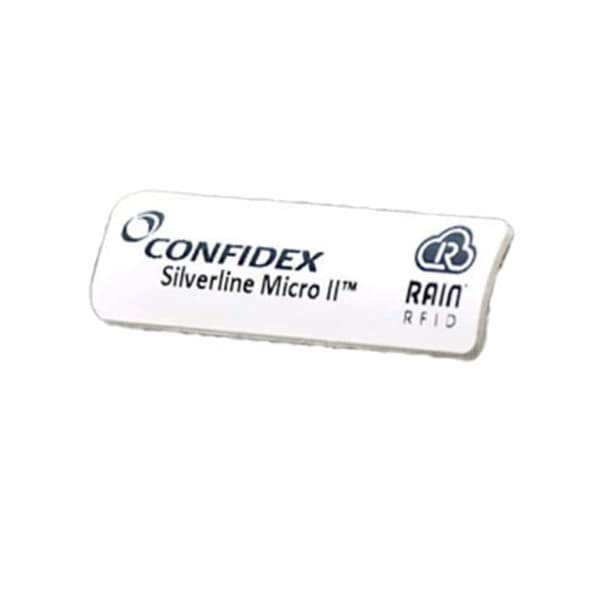
Material, adhesive, form factor and RFID chip determine read range and reliability. Smooth cardboard places different demands than metallic or damp surfaces. Special on-metal labels are used for metal.
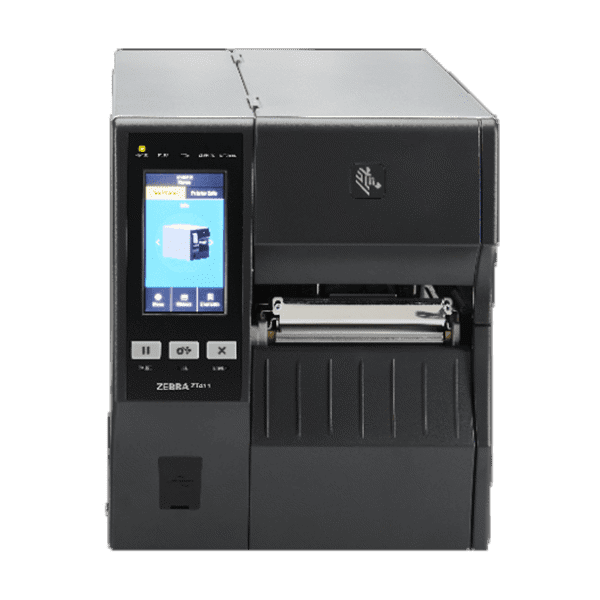
RFID printers print the label visibly and write the chip in the same pass. The result is a label that is readable by people and machines, from desktop and industrial printers to mobile printing at the point of use.
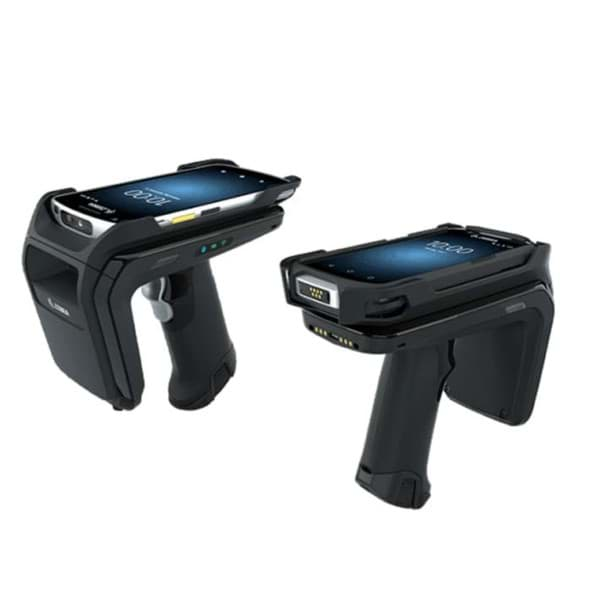
Mobile handheld readers suit stocktaking and spot checks. Fixed readers, antennas and gates capture bulk quantities automatically at dock doors, conveyors or the point of sale. Array readers also determine a tag’s position in real time.
The real value comes when the read points are connected to the ERP system. A clean master data basis is the prerequisite. Postings run automatically, stocks are correct and movement data turns into decisions.
Which form factor suits which point of use?
There is no best RFID reader. There is only the one that suits the point of use.
For searching, re-checking and stocktaking. Examples: Zebra TC22-R and WS501-R.
For the packing station and over-the-counter issue.
For drive-through: the pallet passes the gate and all tags are read at once.
On the line or conveyor, for automatic capture in cycle.
Print and encode in one step, from desktop to industrial: Zebra ZD611R and ZD621R, ZT411 and ZT421 RFID, ZT610 and ZT620 RFID, ZT231 RFID, mobile ZQ630 RFID Plus.
Three questions before choosing
- Is the object moving, or the reader?
- How many tags are read at the same time?
- What happens if a tag is not read: is it noticed or does it slip through?
The third question is the one most often overlooked. A gate without error handling creates confidence that is not justified. That is why we first measure with the real goods: which tags, which position, which antenna orientation.
You can also find hardware and labels in the OPAL Barcode Shop. We are happy to advise you on the selection.
RFID products at a glance
Labels and transponders, readers and printers: each page shows the models in our range with technical data, variants, comparison and frequently asked questions. Prices and availability are in the shop.
Where RFID shows its strength
One read, many items: RFID pays off where many things have to be captured at once. All applications in detail →
Returnable containers are captured automatically at the gate. You always know where each container is, how many there are and in what condition. More on load carriers →
One pallet, one read, instead of scanning each carton individually. Goods receipt and shipping are posted automatically.
The pallet passes the RFID gate, all tags are read at once and the read becomes the posting. The business case depends on how many touchpoints disappear.
Stocktakes in a fraction of the time, with handheld readers at the shelf instead of counting and retyping.
Smart cabinets at the customer’s site or a reading tunnel at the manufacturer: items removed are detected immediately, replaced and invoiced. More on consignment stock →
A unique identifier on the product links it to its data, from the factory to recycling.
Item-level stock for click and collect and ship-from-store. How C&A does it →
How we approach an RFID project
Technology alone does not make a working RFID project. What matters is the interplay of the right label, correctly configured hardware and clean integration.
Frequently asked questions
Barcode or RFID, which is better?
It depends on the application. Barcodes are inexpensive and proven, RFID captures without line of sight and in bulk. We advise honestly on what pays off for you.
Which frequency do we need?
In warehousing, logistics and retail usually UHF, because it reads several metres and many tags at once. HF at 13.56 MHz works at shorter range and is used in healthcare, for example. We test with your goods beforehand.
Does RFID work on metal?
Yes, with special on-metal labels. Metallic and damp surfaces place different demands than cardboard, so we choose the label according to material and application.
Does every goods issue need RFID?
No. The business case is decided not by the reader, but by the number of touchpoints that disappear. Where that number is low, the barcode remains the more economical solution.
Can we print RFID labels ourselves?
Yes. RFID printers print and encode the label in one step. With OPAL Labelmanagement™, the templates come from a central source, directly from the ERP if required.