RFID readers: handheld, fixed and LF readers
Key facts
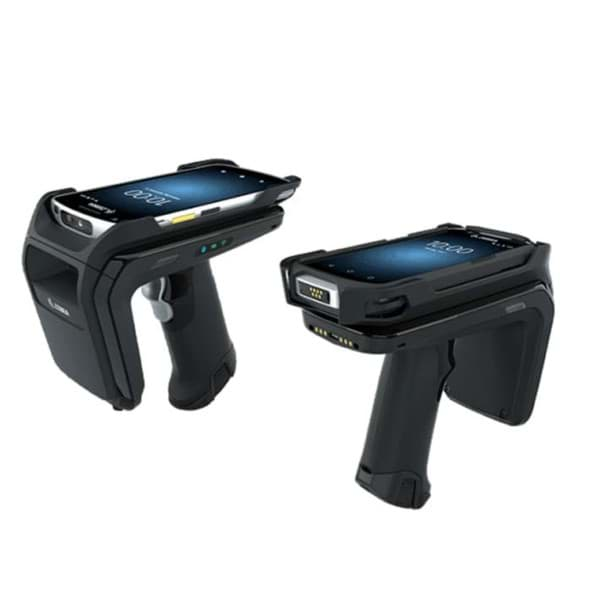
An RFID reader emits a radio field via its antenna, powers passive transponders and receives their data. Handheld readers such as the Zebra RFD40 and the Brady IH40 are sleds: they connect to a mobile computer that runs the application. The Nordic ID Stix is a credit-card-sized USB reader for close range up to 1 m on a PC, smartphone or tablet.
Fixed readers from Kathrein capture transponders automatically at doors, conveyors or shelves. The ARU models have an integrated antenna, while the RRU models work with external antennas such as the WRA 30 for long distances or the U-LoRa for close range up to 20 cm. For 125 kHz transponders such as EM4102 or Hitag, there is the GiS TS-R380 reader and the TS-RW380 and TS-RW380 Plus versions for reading and writing. Basics on the RFID chain and project approach are covered in the RFID overview.
- Stocktaking and searching in the warehouse or store with a handheld reader
- Automatic capture at doors, docks and conveyors with fixed readers
- Checking and encoding individual labels at the workstation (Nordic ID Stix)
- Existing 125 kHz applications with EM or Hitag transponders (GiS TS-R380)
- Printing and encoding labels in volume: an RFID printer is better suited
- Occasional close-range reading without a separate reader: a mobile computer with integrated RFID such as the Zebra TC53e-RFID may be enough
- Reading on metal with standard labels: first choose suitable RFID labels
Detailed specifications
| Zebra RFD40 (handheld) | Kathrein RRU 4500 (fixed) | GiS TS-R380 (LF) | |
|---|---|---|---|
| Form factor | UHF sled with pistol grip for mobile computers | fixed UHF reader with 4 external antenna ports (R-TNC) | LF reader with integrated antenna, external antenna optional |
| Frequency | UHF, 865 to 868 MHz (EU) | UHF, 865 to 868 MHz (ETSI), FCC version 902 to 928 MHz | LF, 125 kHz |
| Protocols and transponders | EPC Class 1 Gen 2, EPC Gen2 V2, Gen2X | EPC Gen2v2, ISO 18000-63, UCODE DNA | including EM4102, EM4200, Hitag 1, Hitag 2, Hitag S, ATA5577, EM4305 |
| Transmit power | 0 to 30 dBm EIRP | 33 dBm conducted (ETSI), 33 dBm ERP | not specified |
| Read range (manufacturer) | up to 12 m (nominal) | depends on antenna and transponder, not specified | up to 100 mm, depending on transponder size |
| Read rate | more than 1,300 tags per second | not specified | not specified |
| Interfaces | eConnex, USB-C; Premium and Premium Plus also Bluetooth 5.3, Wi-Fi 6, NFC | 2 x Ethernet 10/100 Mbit/s, PoE+, GPIO 4 inputs and 4 outputs | USB 2.0 (HID/COM), Ethernet or RS232 depending on version |
| Special features | Premium Plus with SE4100 imager for 1D and 2D barcodes | Embedded PC with Linux, ARMv7-A dual-core 800 MHz | TS-RW380 writes, TS-RW380 Plus with Hitag authentication and crypto mode |
| Power | 7,000 mAh Li-ion battery, quick-release | 10 to 30 V DC or PoE+, power consumption 25.4 W | via USB, 5 V DC or PoE (Ethernet) |
| Protection rating | IP54 | IP67 | not specified |
| Operating temperature | -10 °C to 50 °C | -20 °C to 55 °C | -10 °C to 55 °C |
| Drop resistance | multiple 1.5 m drops to concrete, 1,000 tumbles from 0.5 m | not specified | not specified |
| Dimensions | 15.1 x 8.4 x 16.65 cm (H x W x L) | 300 x 300 x 71 mm | 80 x 80 x 28 mm, with mounting plate 100 x 80 x 31 mm |
| Weight | approx. 541 g (Standard, Premium), approx. 556 g (Premium Plus) | 4.0 kg | not specified |
Source: manufacturer data sheets and product pages, as of October 2026. Subject to change; individual variants may differ. Prices and delivery times are available in the shop.
Variants and accessories
| Model | Type | Key data (manufacturer or shop) | Note |
|---|---|---|---|
| Zebra RFD40 Standard | UHF handheld reader (sled) | up to 12 m, more than 1,300 tags/s, IP54, 7,000 mAh | Connection via eConnex adapter or USB |
| Zebra RFD40 Premium | UHF handheld reader (sled) | as Standard, plus Bluetooth 5.3, Wi-Fi 6 and NFC tap-to-pair | approx. 541 g |
| Zebra RFD40 Premium Plus | UHF handheld reader (sled) | as Premium, plus SE4100 imager for 1D and 2D barcodes | approx. 556 g |
| Brady IH40 | UHF handheld reader (sled) | up to 6 m, USB and Bluetooth 5.0, 1D/2D barcode scanner, IP54, 433 g | for Brady CT40, CT45, CT60, EDA51 |
| Nordic ID Stix | Credit-card-sized UHF USB reader | up to 1 m (adjustable), 7 x 53 x 79 mm, powered via USB 2.0 | for PC, smartphone and tablet |
| Kathrein ARU 2400 | UHF reader with integrated antenna, indoor | 27 dBm, antenna gain 5.5 dBiC, IP40, Ethernet, PoE+, 3 additional antenna ports | 300 x 300 x 49 mm, 1.86 kg |
| Kathrein ARU 3500 | UHF reader with integrated wide-range antenna (65°) | 30 dBm, IP67, PoE+, 3 antenna ports | Wi-Fi or cellular module on request |
| Kathrein ARU 8500 | UHF reader with circular switched-beam antenna | 33 dBm, IP40, Ethernet, 3 antenna ports | Direction detection |
| Kathrein RRU 4400 | Fixed UHF reader | 4 antenna ports, PoE+, IP67, EPC Gen2v2 | Wi-Fi or cellular module on request |
| GiS TS-RW380 / TS-RW380 Plus | LF reader/writer | as TS-R380, plus writing; Plus with switchable modulation | 125 kHz |
Antennas and accessories
- Kathrein WRA 30: wide-range antenna, 11 dBiC, circular, 865 to 868 MHz, up to 18 m (shop data), N socket
- Kathrein U-LoRa: close-range antenna for read zones up to 20 cm, 865 to 928 MHz
- Kathrein antenna cables 3 m and 6 m, adapter cable and Ethernet connection cable
- Kathrein wall mounting kit, also available as indoor version
- Zebra RFD40: spare 7,000 mAh battery, eConnex adapters and charging cradles for TC21/TC26 and EC50/EC55
- Brady IH40: mounting bracket and adapter for the CT40 charging base
Zebra RFD40 or Brady IH40?
| Zebra RFD40 Premium Plus | Brady IH40 | |
|---|---|---|
| Read range | up to 12 m (nominal) | up to 6 m (normal) |
| Read rate | more than 1,300 tags per second | not specified |
| Connection | eConnex, USB-C, Bluetooth 5.3, Wi-Fi 6 | USB, Bluetooth 5.0 |
| Barcode | SE4100 imager, 1D and 2D | integrated 1D/2D barcode scanner |
| Battery | 7,000 mAh | 4,000 mAh |
| Sealing and drops | IP54, multiple 1.5 m drops to concrete | IP54, multiple 1.2 m drops to concrete |
| Operating temperature | -10 °C to 50 °C | -10 °C to 40 °C |
| Mobile computers | Zebra TC21/TC26, EC50/EC55; TC53e/TC58e according to Zebra via Bluetooth, NFC or eConnex | Brady CT40, CT45, CT60, EDA51 |
Both sleds turn a mobile computer into a UHF handheld reader. The deciding factor is usually your existing device fleet: if you work with Zebra devices, the RFD40 fits; with Brady devices, the IH40. According to the manufacturers, the RFD40 offers the longer range and the larger battery, while the IH40 is lighter. If you only read occasionally at close range, you may not need a separate reader: the Zebra TC53e-RFID has an integrated UHF reader with a range of 1.2 m according to the manufacturer.
What OPAL adds
Frequently asked questions
Handheld reader, fixed reader or RFID in the mobile computer?
Handheld readers suit stocktaking and searching, where staff walk to the objects. Fixed readers capture goods automatically at fixed points such as doors or conveyors. A mobile computer with integrated RFID such as the Zebra TC53e-RFID reads up to 1.2 m according to the manufacturer and is sufficient for occasional close-range reading.
Which mobile computers work with the Zebra RFD40?
According to Zebra, the RFD40 connects to the TC21/TC26 and the EC50/EC55 via eConnex adapters. The TC53e/TC58e spec sheet names the RFD40 as a sled connected via Bluetooth, NFC or eConnex adapter. Only the Premium and Premium Plus models have Bluetooth.
When do I need an LF reader such as the GiS TS-R380?
When your transponders work in the 125 kHz band, for example EM4102, EM4200 or Hitag. According to the shop, the TS-R380 reads up to 100 mm depending on transponder size and connects via USB, Ethernet or RS232. For writing transponders there is the TS-RW380.
Which antenna do I need for fixed readers?
That depends on the read zone. The Kathrein WRA 30 is designed for long distances up to 18 m according to the shop, the U-LoRa for close range up to 20 cm. The ARU readers have an integrated antenna plus additional ports, while the RRU 4500 has four ports for external antennas.
What are the benefits of PoE+ on Kathrein readers?
With PoE+, power and data run over one Ethernet cable, so no separate power supply is needed at the mounting point. According to the data sheets, the RRU 4500 and the ARU 2400 can be powered via PoE+ or locally with 10 to 30 V DC.
How does the RFID data get into my ERP?
With handheld readers, the app on the mobile computer processes the tags read. Fixed readers deliver data via Ethernet to middleware or directly to your application. We set up the connection to your ERP or warehouse management system with you as part of our integration services.
Data sheets and manufacturer information
The manufacturer provides data sheets, user guides and configuration guides on the product page. We are also happy to send you the documents directly.