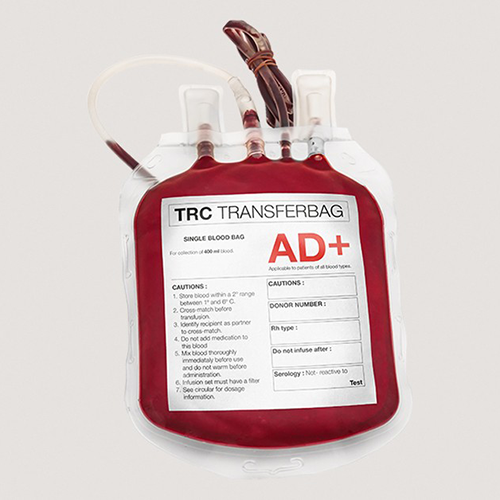
Anyone who has ever donated blood knows how many labels are needed for it. The most important one is stuck directly on the blood bag – and has to withstand the highest demands.
THE CORE PROBLEM
The tough lifecycle of a blood bag
Thanks to expanded donation options and better transfusion methods, giving blood is an uncomplicated, fast process from the donor’s perspective. Transporting blood and its components from donor to end user, by contrast, is complex: blood processing and blood transport require special label materials that withstand the tough lifecycle of a blood bag and convey critical information about origin and contents.
Blood bags are high-volume, high-value products with a fast-moving supply chain. To minimise the risk of a mistransfusion and inventory losses, label developers must take a number of factors into account.
THE REQUIREMENTS
Regulations, traceability, material performance
Regional regulations govern the packaging and labels of blood bags. The Food and Drug Administration and ISEGA define criteria so that label materials such as adhesives do not migrate through plastic blood bags and bottles and contaminate blood components.
From a safety perspective, labels are also the source of traceability: with printed barcodes, companies and medical staff monitor the blood bag on its way – until it reaches the right facility and the right patient.
From collection through processing to storage, primary and secondary labels must withstand extreme conditions and offer the following performance characteristics:
- →Temperature resistance in heat and cold
- →High adhesion on various types of plastic
- →Low adhesive migration
- →Conformability – blood bags are generally not rigid
At the same time, the print on the label must remain intact throughout the entire lifecycle so that important information can be easily interpreted.
THE TECHNOLOGY
RFID and sensors secure the cold chain
Increasingly, blood-bag labels are equipped with RFID and coupled sensors. In addition to the ID number, these also transmit the bag’s temperature history – compliance with the cold chain is monitored and secured without gaps.
This means, for example, that blood bags held in reserve but not used can easily be returned to storage – instead of being destroyed as a precaution simply because they once left the secure store.

FOR YOUR FACILITY
Everything from a single source – from consulting to maintenance
OPAL looks after you competently, with quality expertise and a passion for labels. We meet your individual performance requirements with a unified approach: consulting, software, barcode scanners, WLAN, label printers, consumables and maintenance from a single source. Your advantage: a single responsible point of contact.
Special labels for demanding applications? Ask us your questions – we look forward to it!
OPAL – your partner for labels, printing and AutoID
Adhesive materials, ribbons and special formats for every application, tested for cold, heat, moisture and chemical exposure.