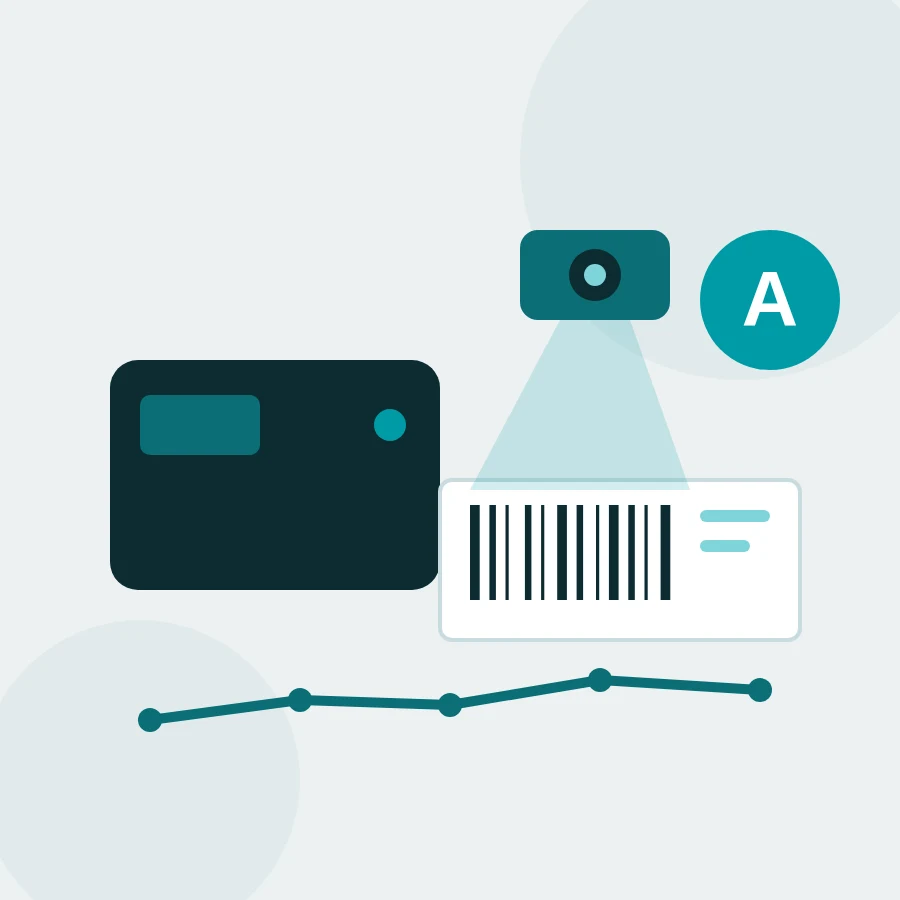
Labels rarely go bad overnight. They get worse slowly: a printhead wears, a batch of material varies, a setting was changed for another job. Without measurement, the first person to notice is outside your company, and by then the pallet is already on its way.
Inline verification grades every label at the moment it is printed. That turns print quality into proof that holds up in an audit.
Spot check or inline: the difference is timing
There are several stations between printer and customer. Where you check decides when a fault shows up.
-
1Spot check
A spot check tests whatever is in your hand. If a fault slips through, it often only shows up at the customer’s goods receipt.
-
2Inline check
An inline check grades every label that is printed. A fault shows up the moment the label leaves the platen roller.
-
3Stop
If the result is out of spec, the line stops before the pallet leaves. Any later, working time, transport and a delivery date would already be used up.
-
4Proof
Every label produces a measurement. The only question is whether it is discarded or stored with the job.
Reading is not verifying
A scanner answers one question: readable or not. A verifier answers a different one: how well is the code printed? A barcode that reads today with a good scanner can fail with a weaker scanner at the customer. The grade shows this gap before it becomes a problem.
Grading follows fixed measurements. For linear barcodes, ISO/IEC 15416 defines these five among others:
| Parameter | What is measured |
|---|---|
| Symbol contrast | The difference between light and dark areas. |
| Modulation | How evenly this contrast holds across the whole code. |
| Defects | Voids and spots in bars and spaces. |
| Decodability | How closely bar and space widths match the specification. |
| Edge contrast and minimum reflectance | Whether the reader detects every edge reliably and the bars are dark enough. |
On each scan line, the weakest parameter sets the grade. The overall grade is the average across several scan lines.
From measurement to proof
“We check our labels” does not convince an auditor. A record per label, stored with the job, does:
The effort is smaller than it sounds, because inline checking produces the data anyway.
Stored over weeks, the grades also show a trend. You can see which printer is slipping and which material varies, and replace the printhead before the pallet comes back.
What hardware, software, service and consumables contribute
Printing and checking that fit the line
Depending on the line, the check sits in the printer or as a camera after printing. What matters is a print system that fits the environment and the load, from the industrial printer in shift operation to the print engine in the applicator. More on print and verify.
One template, one source
Many faults start before the printer: the wrong template, copied values, different settings at each site. With OPAL Labelmanagement™, labels come from one source across the company, directly from the ERP if you wish. The check results belong to the same job.
Maintenance based on measurements
A falling grade is a maintenance signal. Maintenance at intervals that suit your operation keeps print quality and availability stable before a complaint arrives.
Match material and ribbon
Fluctuating print quality often comes from the combination of printer, settings, label and ribbon. OPAL makes labels in its own production and tests adhesion, durability and printability in its own lab.
When a spot check is enough
Not every line needs inline checking. For small volumes, purely internal labels and no quality requirement from your customers, a regular spot check with a handheld verifier is often enough.
- volumes are small
- labels are only used internally
- no customer sets a minimum grade
- customers set a grade
- returns are expensive
- proof is required for every label
Frequently asked questions
Does a scanner replace a verifier?
No. A scanner tells you whether a code was read. A verifier tells you how well it is printed, following a standard method.
Which grade is good enough?
This is usually set by your customer or your industry. If a minimum grade is required, you will find it in your customer’s label specification.
Does this also apply to 2D codes?
Yes. For 2D codes such as DataMatrix and QR, ISO/IEC 15415 applies, with its own parameters.
We show you where a check fits in your line and which data you gain from it.
- ISO/IEC 15416: print quality test specification for linear barcodes
- ISO/IEC 15415: print quality test specification for two-dimensional symbols