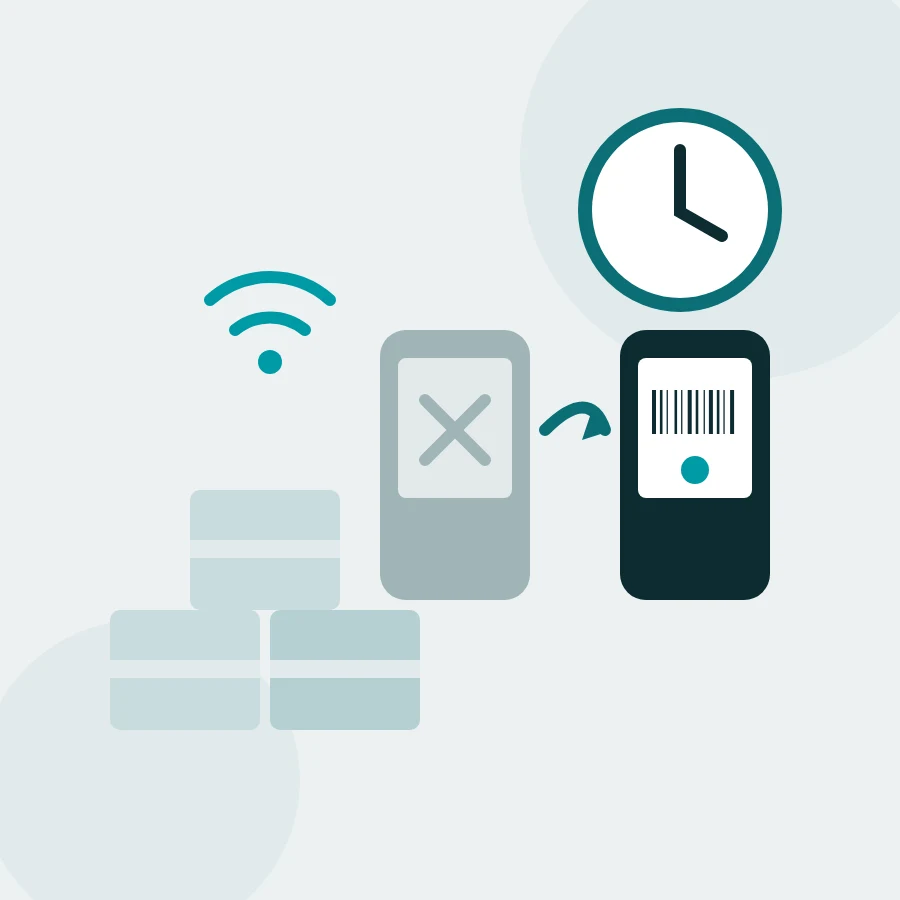
During the year-end peak, every device failure costs more. Behind each picking order more orders are waiting, and every minute without a posting backs up the whole chain. How quickly a replacement device is posting again is decided before the season starts.
It pays to look at the whole chain once: device, software, network, service and consumables. The more of it is prepared, the shorter the downtime.
From failure to the first posting
There are more steps between a broken device and the next posting than you notice in day-to-day work:
-
1Detect
The fault is noticed and reported. If device health is monitored, a problem often shows up earlier.
-
2Fetch a spare
A replacement device is fetched, fastest from a spare pool on site.
-
3Set up
The device gets its operating system, apps and settings. With mobile device management this happens centrally, without anyone setting it up on site.
-
4Connect
It connects to the Wi-Fi. For that, the network has to hold up with the warehouse at full capacity.
-
5Post
The first posting goes into the ERP. Only now is the replacement really in use.
Almost every one of these steps can be prepared before the season.
What hardware, software, service and consumables contribute
Few device types
Device fleets usually grow with each individual purchase. Seven device types mean seven spare parts stocks, seven images and seven update cycles. The fewer types in use and the more uniformly they are set up, the easier a swap becomes. A small spare pool on site is part of it.
One image for every replacement device
With mobile device management, replacement devices are ready and preconfigured. Apps, settings and the Wi-Fi profile are pushed to the device centrally. At the same time, device health is monitored so problems show up early.
Response times that match your shifts
A managed services contract sets out response times, availability and scope in writing, for example a spare device pool, monitoring and updates. Check whether the agreed times also apply to the late shift and Saturdays.
Plan seasonal demand early
More shipments need more labels and more ribbon. If you plan demand early, you won’t be printing on leftover stock or unsuitable material in December. OPAL has been making labels in its own production since 1996 and matches material and ribbon to the printer and the application.
Wi-Fi under load
Metal racking, forklifts and changing stock levels constantly change how the radio signal spreads. A network that is fine in an empty warehouse can drop out when the hall is full. A site survey shows in good time where it needs to be improved.
Checklist before the season
- How many device types are in use, and is there a current image for each?
- Are spare devices on site, configured and charged?
- How long does it take today from a failure to the first posting?
- Does the agreed response time also apply to the late shift and on Saturdays?
- Does the Wi-Fi hold up with the hall full, or was it last measured in an empty warehouse?
- Have labels and ribbons for the season been ordered and are they on site?
When a service contract with spare devices is enough
Not every operation needs a full managed service. With a few devices at one site and in-house IT that can look after the warehouse, a service contract with spare devices is often enough. You can start small and extend the scope later.
- a few devices are in use at one site
- in-house IT looks after the warehouse
- you want to start small and extend later
- Maintenance and support
- Spare device pool
- Monitoring and updates
- Monthly reporting
- Response times set out in writing
What OPAL contributes
At OPAL you have one contact for devices, software, network, service and consumables.
What this looks like in practice: managed services for peak season.
Frequently asked questions
What does a managed services contract include?
Depending on your needs, maintenance, support, spare devices, monitoring and updates. The scope is agreed individually for each operation.
Do you also support devices that were not bought through OPAL?
In many cases, yes. After a review of your equipment you know which devices we can take on.
Is it too late for this season?
For a complete rebuild, usually yes. A review, an image for the most important device types and a spare pool are often still possible.
We review your devices and network and show where you can gain time before the season.