


Entrust SD260 and SD360
Key facts
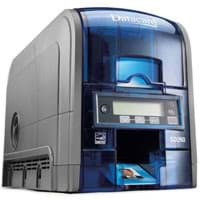
The Entrust (formerly Datacard) SD series consists of compact direct-to-card printers for ID cards in small to medium runs. Both models print at 300 dpi using dye sublimation and thermal transfer directly onto PVC cards in CR80 format. They share the print engine, ribbons, interfaces and encoding options.
The difference is the reverse side. The SD260 prints one side; you print the back only by feeding the card again by hand. The SD360 turns the card itself and prints both sides in one pass. In the shop you will find the SD260 and the SD360 as a used unit. Entrust no longer lists the SD series on its current product page, which now shows the Datacard DS1, DS2 and DS3 direct-to-card models.
- Employee and visitor badges with photo in small runs
- Single-sided cards with logo, name and barcode (SD260)
- Dual-sided badges, for example with instructions on the back (SD360)
- Cards with magnetic stripe for time recording or access control
- Existing SD installations that should keep running with the same consumables
- New projects with current operating systems and Wi-Fi connectivity: Zebra ZC series
- Adding chip encoding later (contact, contactless or UHF) on the SD260: Zebra ZC350
- Printing from Linux or macOS: Zebra ZC series
- Large card volumes in continuous operation or retransfer printing: talk to us
Detailed specifications
| SD260 | SD360 | |
|---|---|---|
| Print method | Direct-to-card, dye sublimation and resin thermal transfer | same as left |
| Printing | single-sided, edge to edge; back side only by turning manually | single or dual-sided automatically, edge to edge |
| Resolution | 300 dpi, 256 shades per colour panel | same as left |
| Print speed single-sided | colour (YMCKT) up to 200 cards/h, monochrome up to 830 cards/h | same as left |
| Colour dual-sided (YMCKT-K) | not supported | up to 155 cards/h |
| Card format | ISO ID-1 / CR80, 85.6 × 53.98 mm | same as left |
| Card thickness | 0.254 to 0.939 mm (10 to 37 mil) | same as left |
| Card input and output | 100 cards automatic (0.76 mm) or single card manual; output 25 cards, optional 100 | 100 cards automatic, optional 200; output 25 cards, optional 100 |
| Magnetic stripe | ISO 7811 three-track (HiCo and LoCo), JIS Type II single-track, field upgradeable | same as left |
| Smart card (contact and contactless) | all-in-one reader with HID iCLASS, factory option only | all-in-one reader with HID iCLASS, field upgradeable |
| Interfaces | USB 2.0, Ethernet 10/100 | same as left |
| Operating systems per datasheet | Windows XP SP3 to Windows 7, Windows Server 2003 R2 and 2008 | same as left |
| Security | card remake disabling, print block over the magnetic stripe, optional Kensington lock | same as left |
| Dimensions (L × W × H) | 39.1 × 17.5 × 22.4 cm | 53.9 × 17.5 × 22.4 cm |
| Weight | 3.7 kg (depending on options) | 5.4 kg (depending on options) |
| Operating environment | 15 °C to 35 °C, 20 to 80 % relative humidity, non-condensing | same as left |
Source: manufacturer data sheets and product pages, as of October 2026. Subject to change; individual variants may differ. Prices and delivery times are available in the shop.
Variants and accessories
| Version in the shop | Printing | Card feed | Magnetic stripe |
|---|---|---|---|
| Datacard SD260 | single-sided | manual or automatic | with or without encoder |
| Datacard SD360 (used) | single and dual-sided | automatic | without encoder, available as an accessory |
Accessories and consumables
- Output hopper for 100 cards (SD260 and SD360)
- Magnetic stripe encoder for retrofitting
- 300 dpi colour printhead as a spare part
- YMCKT ribbon kits for 250 or 500 cards; for dual-sided printing YMCKT-K (375 cards) and YMCKT-KT (300 cards)
- Monochrome ribbons in black, dark blue, white and gold for 1,500 cards each
- CardFive Vision card design software and white 30 mil PVC cards
Entrust SD series or Zebra ZC series?
| Entrust SD260 / SD360 | Zebra ZC100 / ZC300 / ZC350 | |
|---|---|---|
| Print method | direct-to-card, 300 dpi | direct-to-card, 300 dpi |
| Colour single-sided | up to 200 cards/h | ZC100 up to 150, ZC300 up to 200, ZC350 up to 225 cards/h |
| Colour dual-sided | SD360 up to 155 cards/h | ZC300 up to 140, ZC350 up to 150 cards/h (dual-sided models) |
| Chip encoding | contact and contactless (iCLASS) as an option | ZC350: contact, contactless (MIFARE) and UHF, field upgradeable |
| Interfaces | USB 2.0, Ethernet | USB 2.0, Ethernet (optional on ZC100), optional 802.11ac Wi-Fi |
| Operating systems per datasheet | Windows up to Windows 7 | Windows up to Windows 10, Ubuntu, macOS |
| Manufacturer warranty per datasheet | 30 months depot, 30 months printhead | 3 years on printer and printhead |
Both series print directly onto the card and suit ID cards in small to medium runs. The SD series fits if you already use SD printers with their ribbons or need a straightforward printer for magnetic stripe cards. For a new project with current operating systems, Wi-Fi or chip encoding added later, the Zebra ZC series is the obvious choice. To the Zebra ZC series
What OPAL adds
Frequently asked questions
What is the difference between the SD260 and the SD360?
Both use the same 300 dpi print engine and the same encoding options. The SD260 prints one side; for the back you feed the card again by hand. The SD360 has a card flipper and prints both sides in one pass, according to the manufacturer up to 155 colour cards per hour. This makes it longer and heavier.
Can I add a magnetic stripe encoder later?
Yes. According to the datasheet, the magnetic stripe encoder (ISO 7811, HiCo and LoCo) is field upgradeable on both models, and you will find it as an accessory in the shop. A smart card module is a factory option on the SD260 and can be retrofitted on the SD360.
Which ribbons do I need?
For colour badges with a photo, use YMCKT ribbons; for dual-sided printing on the SD360, YMCKT-K or YMCKT-KT. For text and barcode cards, monochrome ribbons are sufficient, available in the shop for 1,500 cards each. According to the manufacturer, the printer identifies the loaded ribbon automatically.
Which cards can be printed?
Cards in ISO ID-1 format (CR80, 85.6 × 53.98 mm) with a thickness of 0.254 to 0.939 mm, i.e. 10 to 37 mil. According to the datasheet, PVC cards with a glossy surface, selected key fob cards and adhesive-backed cards are suitable. The usual card is 30 mil, or 0.76 mm.
Do the printers run on current Windows versions?
The datasheet lists Windows XP SP3 to Windows 7 and Windows Server 2003 R2 and 2008. Entrust provides drivers for the SD series on its support page. We check with you before purchase whether your Windows version and your badge software are supported.
Is there a successor?
Entrust does not name an official successor on the pages we checked. Its current product page no longer lists the SD series and shows the Datacard DS1, DS2 and DS3 direct-to-card models instead. For a new project, we will gladly advise you on a current printer.
Data sheets and manufacturer information
The manufacturer provides data sheets, user guides and configuration guides on the product page. We are also happy to send you the documents directly.