Every picking run contains one moment that costs productivity and shows up in no report: the second your operator reaches for the device instead of the goods. Pick-by-voice removes exactly that second. This article shows how to tell whether your warehouse benefits, before you invest.
The real bottleneck is not speed, it is the hand
Most warehouses we visit stopped working on paper long ago. There are mobile computers, there are scanners, the processes are digital. And yet one movement remains, repeated at every single pick: device out of the holster, read the display, grab the goods, scan, put the device away again or keep holding it.
Pick-by-voice intervenes exactly here. The operator wears a headset, hears the next task and confirms by speaking. No display, no device in hand, no looking down. Scroll through one pick:
Take the device out of the holster, read the display, grab the goods, scan, put the device away again. Each of those movements costs seconds, ties up a hand and pulls the eyes off the aisle and onto a screen.
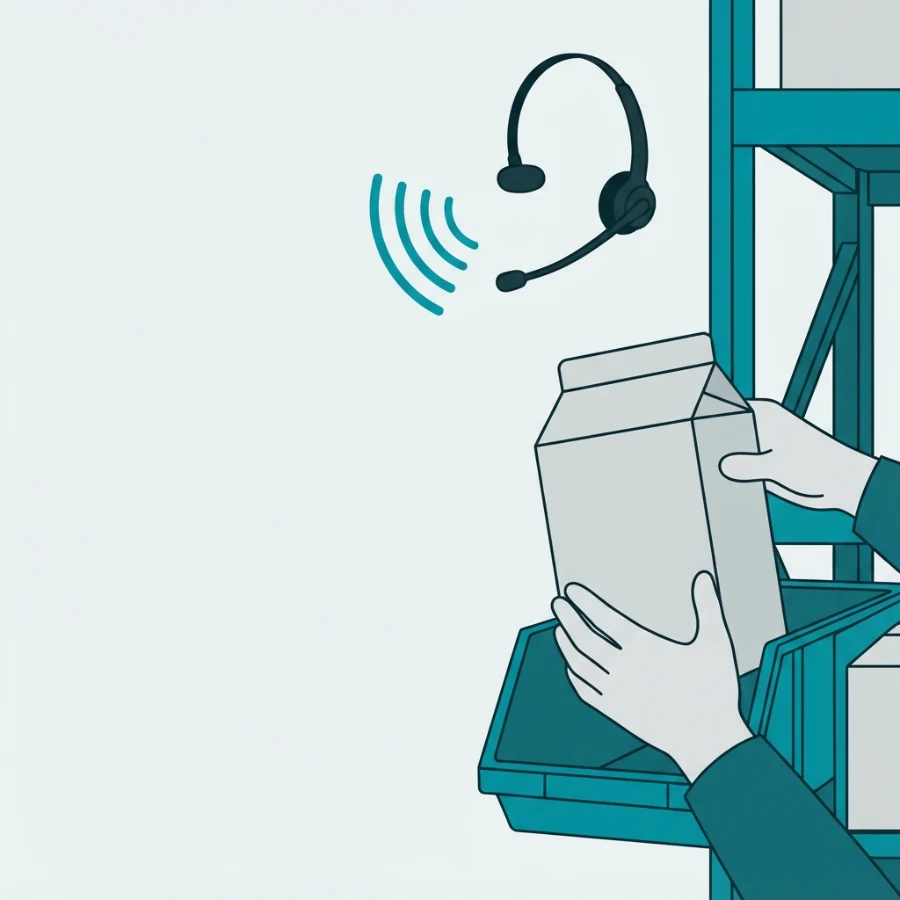
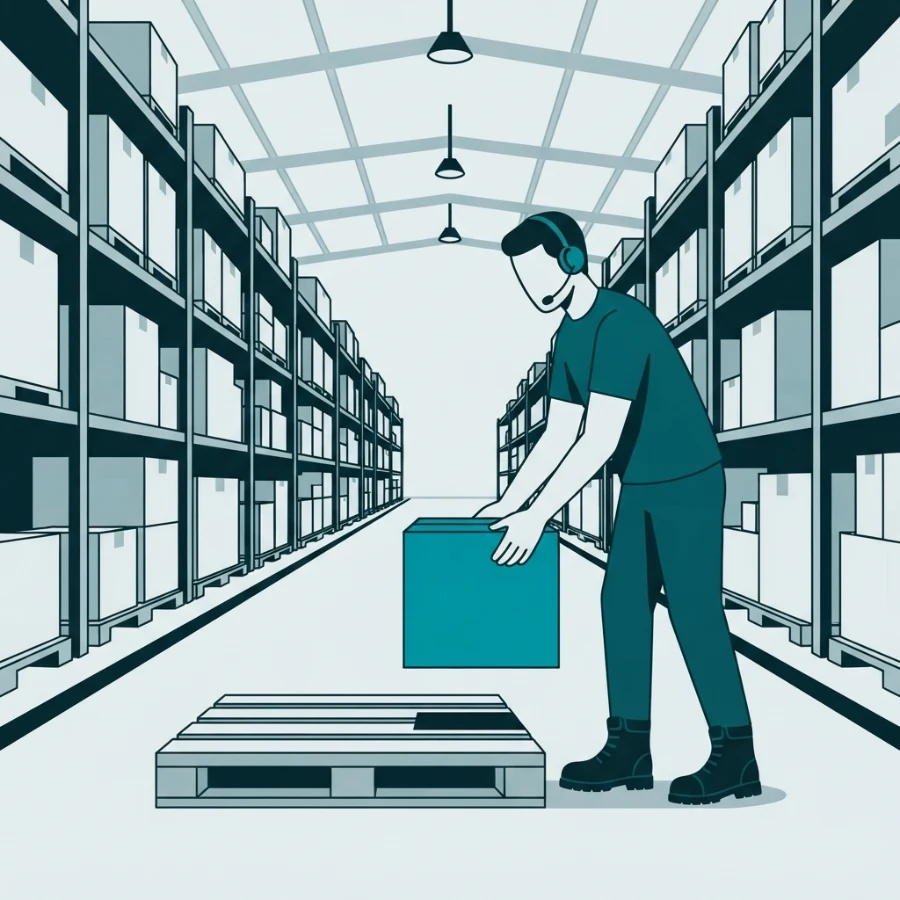
Hear the instruction, grab the goods with both hands, speak the check digit. Both hands stay on the goods, the eyes stay on the aisle.
At 40 picks per hour that is 320 repetitions in an eight-hour day in which two movements fall away. With a handful of pickers that is background noise. From ten operators picking eight hours a day it becomes a figure you can calculate.
What a pick actually sounds like
Voice is not a read-aloud system. It is a short, closed dialogue that confirms every step before the next one arrives. Scroll through a single pick:
Aisle and slot come through the headset. No display, no looking down.
The operator reads back the check digit printed at the slot. That does not confirm they heard the instruction, it confirms they are actually standing in the right place.
Every step is confirmed before the next one arrives.
Both hands stay on the goods.
This single feedback loop is why voice picking is so reliable.
What changes for the people in the warehouse
The benefit of voice does not lie in the technology, it lies in what the operator no longer has to do. Six effects that show up most clearly in practice:
No switching between device and grip, no putting down, no searching. Especially noticeable in cart picking and tote picking, where both hands are needed anyway.
The dialogue guides them through the process instead of the process having to be learned first. Someone starting on Monday does not need to understand menu navigation, only to listen and answer.
The dialogue runs in the operator’s own language while the process stays identical. A team with five native languages works in one system without anyone translating.
The spoken check digit is a real control at the rack. A wrong slot surfaces at the moment of access, not later in inspection or at the customer.
Whoever is not looking at a display sees the forklift. In warehouses with mixed traffic that is a safety argument every works council understands immediately.
Multi-order picking, replenishment, stocktaking and goods receipt can all be mapped in the same dialogue model. Voice rarely stays limited to picking.
In deep-freeze areas voice shows its greatest strength: gloves stay on, nobody has to read a fogged-up display, and every interaction saved shortens the time spent in the cold. Voice needs neither a free hand nor a display. That is why cold storage is always worth a closer look for us, as soon as the remaining criteria are met.

Voice, mobile computer or back-of-hand scanner: what fits where
Voice is not automatically the best solution. It is the best solution for a particular process profile. A direct comparison makes the boundary visible:
| Criterion | Mobile computer | Back-of-hand scanner | Pick-by-voice |
|---|---|---|---|
| Hands free | No, one hand occupied | Partly, the scan needs alignment | Yes, completely |
| Eyes free | No, the display guides | No, the display guides | Yes, no display needed |
| Onboarding | Menu navigation must be learned | Menu navigation must be learned | Dialogue guides from minute one |
| Multilingual use | One interface per language | One interface per language | One dialogue per language, same process |
| Cold storage | Limited | Good | Very good |
| Strongest in | Full pallets, infrequent picks, data capture with visual checks | High scan intensity over short distances | Man-to-goods, cart picking, multi-order, high pick rates |
The last row is the telling one. Anyone using back-of-hand scanners today has already recognised the need for free hands and covered part of the distance. Those warehouses can often be mapped considerably better with voice.
The self-check: does voice fit your warehouse?
Eight criteria decide in practice whether a voice assessment makes sense. Tick what applies to your warehouse.
There is no fixed limit on item structure or warehouse layout: voice projects vary widely here. What decides is the process, the pick rate, the team size and the challenges you face in picking today.
Where voice is not the answer
We supply mobile computers, back-of-hand scanners and voice. That is why we also say clearly when another route fits better:
Moving whole pallets means few confirmation steps per unit of time. The dialogue then brings little time advantage, because the time sits in transport, not in the pick.
Below ten pickers, and where picking is a secondary activity, the effort for setup, voice profiles and integration usually does not match the benefit.
Where the operator has to see product images, batch details or inspection features on a display, a display makes sense. In those cases a combination is often better than a replacement.
What you get differently at OPAL
Voice technology can be bought anywhere. The question is who assesses whether it fits your process, and who keeps it running afterwards.
Because we supply mobile computers, back-of-hand scanners and voice, we recommend what fits your process, and sometimes advise against one. So you get an assessment that starts from your warehouse.
As a systems integrator we connect voice to your existing system landscape. No system change, no parallel operation, no second version of the truth.
If you already work with us, we know your installation: scanners, printers, labels and processes. We assess voice in combination with what already runs at your site.
Hardware, software, service and consumables from one source, with our own service organisation across the DACH region. No passing of responsibility when something fails.
Frequently asked questions
Does speech recognition work in the noise of a warehouse hall?
Yes. Voice systems use close-talk microphones and a strictly limited vocabulary. The system does not need to understand every word, only to distinguish between a few expected answers. That is precisely why it is more robust than general-purpose voice assistants.
Do operators have to train their voice?
Modern systems start speaker-independent but keep learning per user. The effort is a few minutes per person, not hours. For seasonal staff that is a decisive point.
Do we need a new warehouse management system?
No. Voice sits on top of your existing host system and communicates with it. The integration is the actual project effort, and that is exactly where our role as a systems integrator lies.
What happens to our existing mobile computers?
They stay in use where they are stronger, for example in goods receipt with visual checks or in stocktaking. Voice rarely replaces the entire device landscape, it takes over the processes where free hands make the difference.
How can the potential be quantified in advance?
Reliably only with your real process data: pick rates, travel times, order structure, shift model and the challenges you face in picking today. That is why the first step is not a quotation but a joint process assessment on site.
How hygienic is a headset in multi-shift operation?
There are personalised ear cushions and disinfectable components. In practice this is handled through issuing concepts, much like hearing protection or work gloves.
We come to your warehouse, walk your processes with you and assess without obligation:
- whether pick-by-voice makes economic sense for you
- what productivity potential is realistically achievable
- which processes and areas are particularly suitable
- what a possible entry point would look like in concrete terms